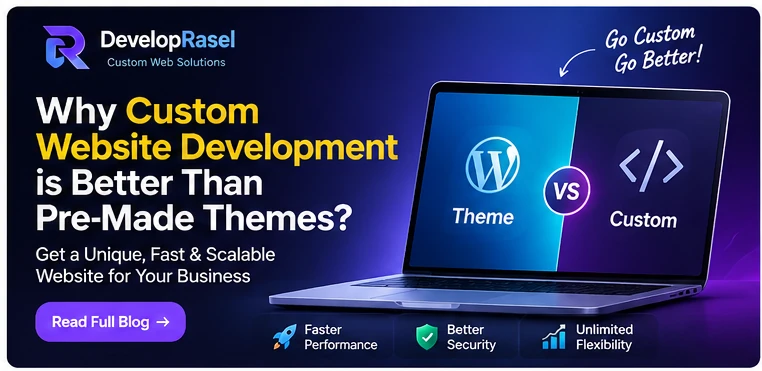
Choosing how to build your business website is not simply a design decision. It affects how customers experience your brand, how easily your team can manage the site, and how well the website can adapt as your business grows. A pre-made theme can be a sensible starting point, while a custom website can be the better long-term investment when your requirements are specific. The right choice depends on what your business needs—not on the idea that one approach is always best.
What is a pre-made theme?
A pre-made theme is a ready-built design system that you install and configure. It usually includes page layouts, typography, color settings and common website components. This approach can reduce initial build time and work well for a straightforward brochure site, personal blog or early-stage project with a limited feature set. Before choosing one, check whether it is actively maintained, accessible, responsive, compatible with your essential plugins and free of features you do not need. A large demo library can look impressive, but unnecessary scripts and bundled functionality may add complexity.
What does custom website development mean?
Custom website development starts with your business goals, user journeys and functional requirements. The layout, components, data structures and integrations are then designed around those needs. With WordPress, that may mean a purpose-built theme, custom blocks, custom post types or a dedicated plugin. A non-WordPress project may use a different front-end and back-end stack. The important distinction is that the architecture is selected to solve the actual problem instead of forcing the business into a generic demo.
Custom vs. pre-made: the practical differences
Design flexibility is usually the most visible difference. A template offers options within its design system; a custom build can support a more distinctive brand and specific user flows. Functionality is another difference: custom development can connect the website to internal tools, APIs, booking systems or tailored workflows. Performance depends on implementation rather than the label—either approach can be fast or slow. A carefully configured lightweight theme may outperform poorly written custom code. Maintenance also matters: custom code needs documentation and updates, while a commercial theme depends on its developer's update quality and compatibility.
When a pre-made theme is enough
Choose a reputable pre-made theme when your needs are standard, the budget is limited, and speed to launch is the main priority. A small service website with a few pages may not need bespoke engineering. Keep the theme lean, avoid installing overlapping plugins, use optimized images and test the site on real mobile devices. You can still customize the design responsibly through a child theme or supported hooks rather than editing vendor files directly.
When custom development is worth considering
A custom build becomes attractive when the website is central to revenue or operations. Examples include a marketplace with role-specific dashboards, a property portal with advanced filters, a membership platform with custom access rules, or a WooCommerce store with unusual product configuration and checkout logic. It can also be valuable when the existing site has accumulated fragile workarounds. Before development begins, define the must-have features, expected traffic, integrations, content model, security requirements and how success will be measured.
How to make the decision
List the user problems your website must solve. Separate essential requirements from features that would merely be nice to have. Compare the full cost of ownership: design, development, licenses, hosting, maintenance, future changes and the business cost of limitations. Ask a developer to explain trade-offs and propose the simplest maintainable solution. The goal is not to build custom code for its own sake; it is to avoid paying for complexity you do not need while leaving room for the capabilities you do.
A practical next step
If you are unsure which route fits your project, prepare a short brief with your audience, page list, reference websites, required integrations and desired launch window. Rasel develops WordPress websites, custom themes and plugins, and tailored business websites. Share the brief through the contact options on Developer Rasel to discuss a solution that fits your requirements.
Frequently asked questions
Is custom website development better than a WordPress theme?
Not automatically. A pre-made theme can be ideal for a standard website. Custom development is useful when your design, workflows or integrations cannot be handled cleanly by an existing theme.
Is a custom WordPress website more expensive?
It often requires more planning and development time up front. The total cost depends on the scope, integrations, content model and ongoing maintenance—not simply whether the site is custom.
Can I start with a theme and customize it later?
Yes. Choose a well-supported theme and keep custom functionality separate where possible. If requirements become complex, a planned rebuild may be safer than stacking workarounds.
Ready to build a better website?
Whether you need a custom WordPress theme, a purpose-built plugin, a WooCommerce enhancement or a complete business website, start with a clear brief and a maintainable plan. Visit Developer Rasel to learn about the services and get in touch about your project.

Developer Rasel
Custom WordPress & plugin developer. I build custom themes, plugins and WooCommerce features for businesses worldwide - and fix broken sites fast.